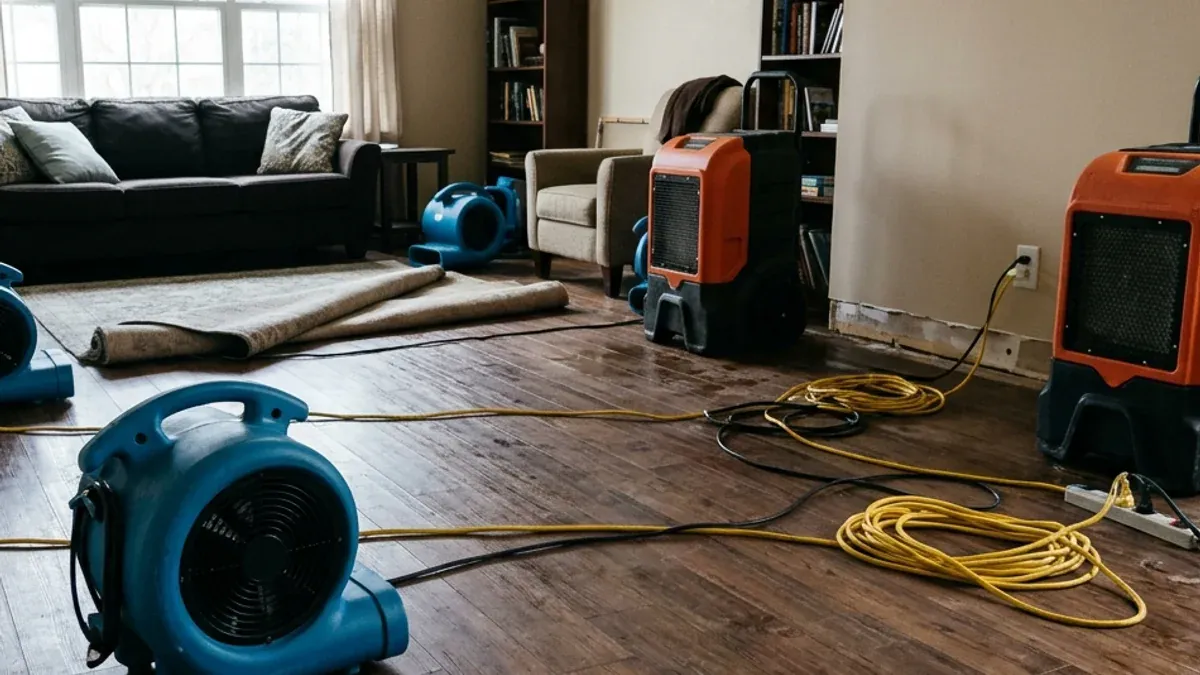
Restoration Standards for Structural Drying and Dehumidification
Structural drying is an advanced science based on psychrometrics—the thermodynamics of air and moisture. Simply removing standing water does not dry the structural framework of a building. Bound water trapped in wall studs, subflooring, and ceiling joists will cause dry rot, warping, and mold if not systematically evaporated and condensed. Local Water Damage HQ deploys commercial drying chambers, high-velocity air movers, and low-grain refrigerant dehumidifiers to return structures to baseline dry standards.
When water infiltrates building assemblies, moisture migrates along structural plates and into subflooring cavities through capillary wicking. Delaying mitigation allows bound moisture to degrade structural fasteners, warp architectural hardwoods, and weaken drywall. At Local Water Damage HQ, our technicians deploy commercial-grade extraction and dehumidification systems to reverse moisture absorption and protect your property's long-term value.
Specialized Equipment Deployed:
- Low-grain refrigerant (LGR) commercial dehumidifiers
- Centrifugal and axial high-velocity air movers
- Digital thermo-hygrometers for GPP and RH calculations
- Pinless radio-frequency moisture meters
- Thermal imaging infrared cameras
How We Execute Structural Drying and Dehumidification
Our structured mitigation process ensures all moisture is safely removed and structural materials are preserved.
1. Psychrometric Baseline Readings
We measure ambient temperature, relative humidity (RH), grains per pound (GPP), and equilibrium moisture content (EMC) in both affected and unaffected rooms.
2. Directional High-Velocity Airflow
Air movers are placed at exact 45-degree angles along walls and floor assemblies to break the boundary air layer and pull moisture into vapor form.
3. Low-Grain Refrigerant (LGR) Dehumidification
Industrial dehumidifiers pull moist air across cold evaporator coils, condensing water into liquid and discharging dry, warm air to continue evaporation.
4. Daily Psychrometric Monitoring & Verification
Technicians log daily moisture points across all affected materials until readings reach certified dry standards, ensuring no hidden moisture pockets remain.
Frequently Asked Questions About Structural Drying and Dehumidification
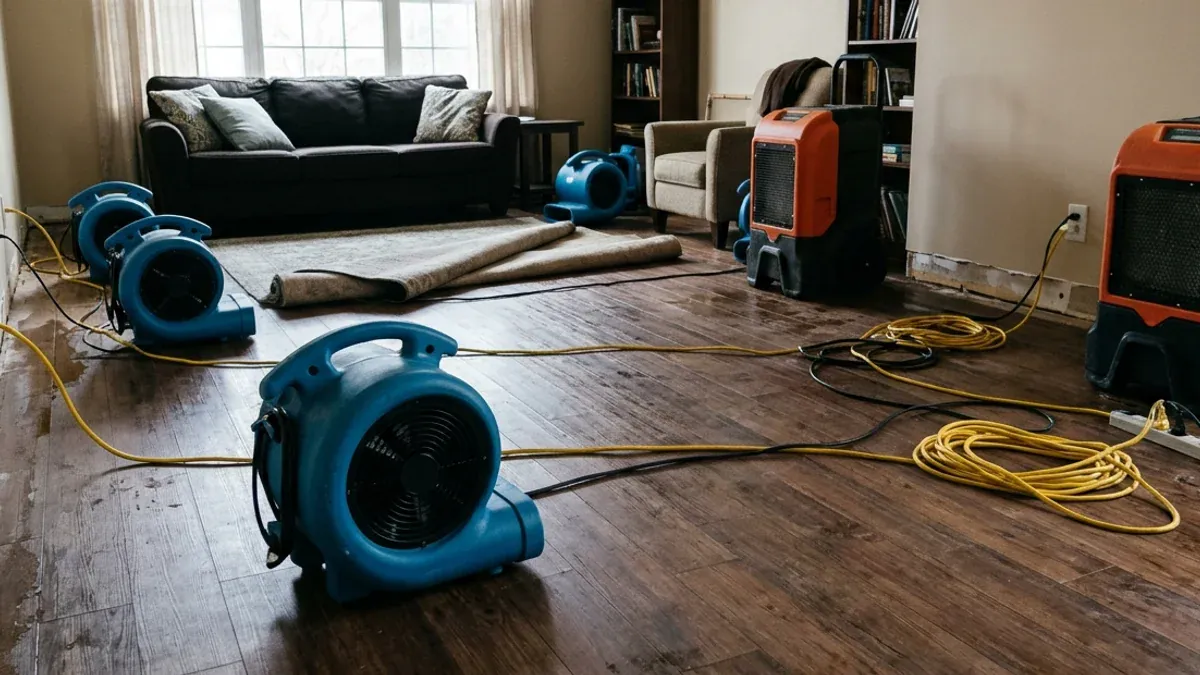
Scientific structural drying uses controlled air velocity, temperature, and specific humidity to evaporate moisture trapped inside solid building materials like framing studs, concrete, and subflooring, preventing structural deterioration.
Household fans only move surface air and lack the velocity to penetrate dense wood or drywall. More importantly, they do not remove moisture from the air—they simply circulate humid air. Commercial dehumidifiers are required to pull moisture out of the building.
We use non-invasive pinless moisture meters that emit electromagnetic signals to detect moisture behind tile and drywall, as well as infrared thermal cameras that highlight evaporative cooling patterns.
A standard structural drying phase typically runs continuously for 3 to 5 days. Our technicians test moisture levels daily and only remove equipment once materials reach certified dry baselines.
A dry standard is determined by taking moisture readings from unaffected wood and drywall in a dry room of your home. The damaged materials are dried until their moisture content matches this baseline.
Facing a Water Damage Disaster?
Do not allow standing water to soak deeper into floors and walls. Contact Local Water Damage HQ immediately for prompt structural drying and dehumidification assistance.
Call Now: 877-408-0342